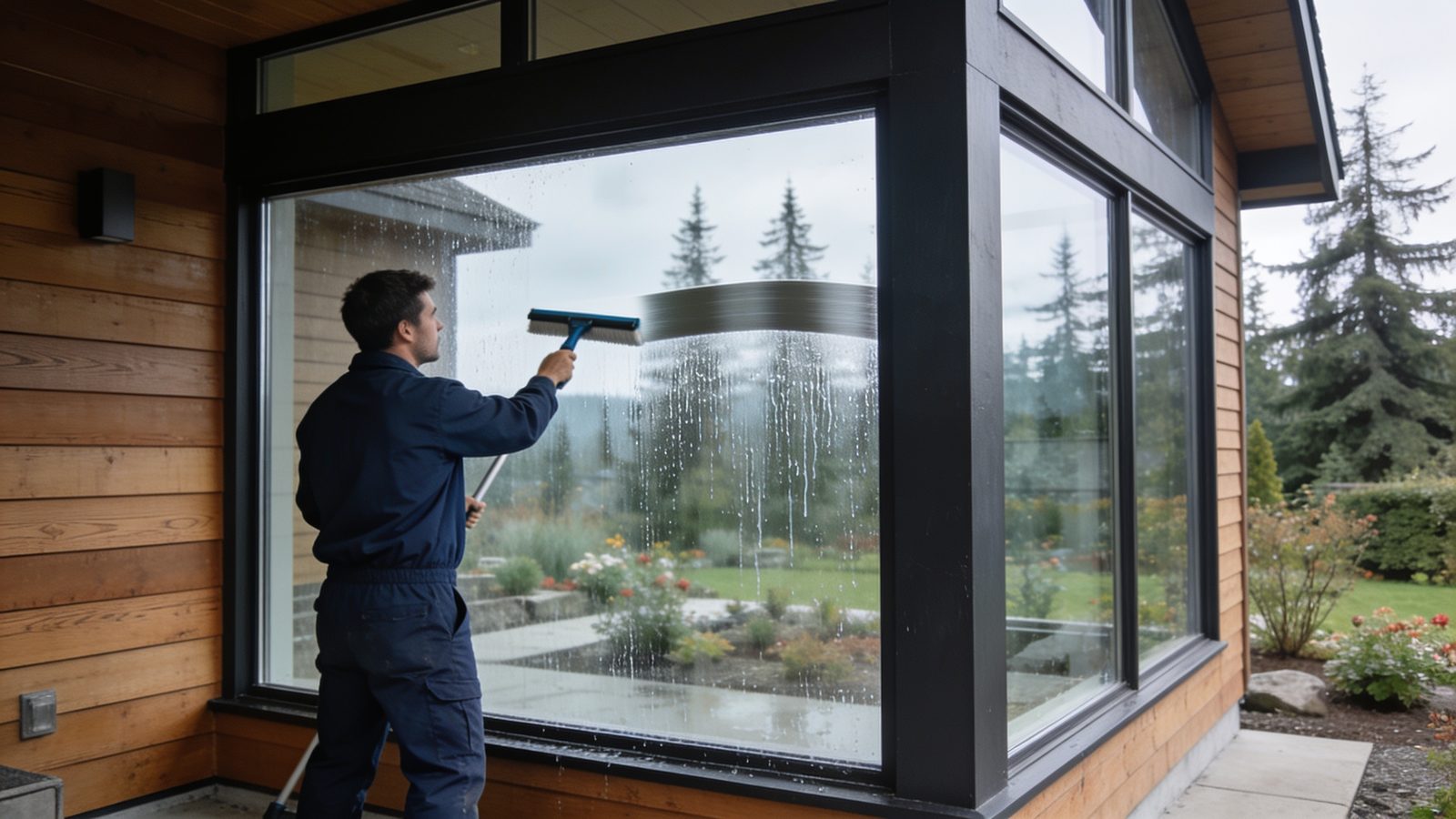
Streaks come from the water, the cloth, or the sun. Here is how to beat all three.

Advice · EKL Cleaning
Written by the EKL Cleaning team
Reviewed by the owner of EKL Cleaning · Updated
To clean windows without streaks, wash out of direct sunlight, pull the water off with a sharp squeegee blade, wipe that blade dry after every single stroke, and clean the frames and sills along with the glass. Almost every streak traces back to one of three things: the water you used, the cloth you dried with, or the time of day you picked.
We're a professional cleaning company working across Metro Vancouver and the North Shore, and streaky glass is the single most common thing we get called in to fix. In almost every case the effort was there and the method was working against it.
Here's what actually causes a streak, the part of it you can fix yourself this weekend, and the point where it stops being worth your time.
A streak is dried residue. Anything still sitting on the pane when the water evaporates turns into a visible line: soap film, dissolved minerals, lint off your cloth, or dirt you pushed around instead of lifting off.
That's why scrubbing harder rarely helps. More effort with the same water, the same cloth and the same timing gives you the same streaks, and a sore arm.
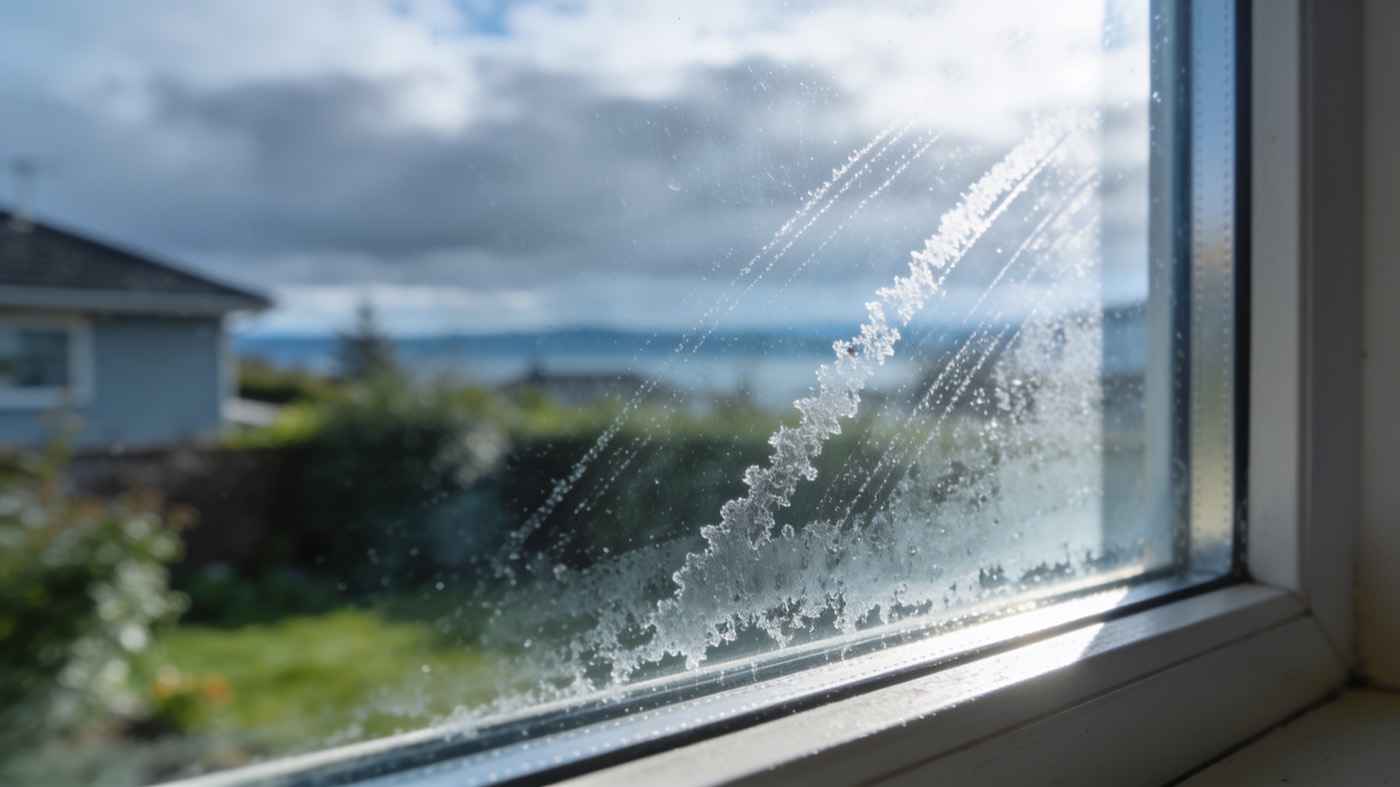
The pattern on a redo is consistent: streaky glass, debris still sitting in the sills, and sections missed around the edges. All three trace back to the same handful of causes, and all three are fixable.
If you live in Metro Vancouver, hard water is almost certainly not what's streaking your windows. Our water comes off the Capilano, Seymour and Coquitlam watersheds, and Metro Vancouver's own 2024 testing measured treated tap water between roughly 2 and 24 milligrams per litre of calcium carbonate (Metro Vancouver, 2024). Water below 60 milligrams per litre is generally considered soft (World Health Organization, 2011), so ours sits well inside that band.
That changes what's worth your money here. Buying distilled water to beat mineral spotting makes sense in a hard water city. In Metro Vancouver your effort pays off faster on the sun, the cloth and the squeegee.
Three things do leave mineral marks on glass in this region, and none of them are your kitchen tap:
Water purity still matters for how we work, just for a different reason. On higher outside windows we run a water fed pole with a 100% pure filtered water system. The filtering strips everything out of the water first, so when it dries there's nothing left behind to leave a mark at all. Every pane gets scrubbed and then rinsed with that pure water, and it dries clear on its own with nothing touching it.
At home, bottled distilled water is the closest you'll get to that. It's worth knowing the swap does far less here than it would somewhere with hard water.
Sun on the glass dries your cleaning solution before you've finished spreading it, and every dried patch edge becomes a line. Pick an overcast day, or follow the shade around the house and do each side while it's out of the sun.
Vancouver makes this the easiest rule on the list to follow for most of the year. On a clear day, start on the east side early while it's still cool, and save the west-facing glass for late afternoon once the sun has come off it.
Warm glass counts too. A pane that had sun on it an hour ago is still hot enough to dry your solution in patches. Put a hand on it before you start, and if it's warm to the touch, move to another side of the house and come back.
Paper towel is the most common streak cause we find in a customer's own kit. It sheds lint across the pane and pushes dirt around instead of lifting it off, so you finish with a window that looks worse in daylight than it did when you started.
Use lint-free microfiber, and use two of them. One damp cloth for washing, one bone dry for the edges and the final buff. Keeping them separate is most of the difference.
More soap gives you more film. A few drops of dish soap in a full bucket of warm water is enough for a whole house, and going past that is what leaves the sticky residue that dries into lines.
Rinse heavy dirt off with plain water first if the glass is filthy. Washing straight into a layer of grit means you're dragging that grit across the pane, which is how fine scratches start.
A squeegee with a sharp rubber blade pulls the water off the glass in one clean sweep, which is the entire reason to own one. The technique is simple and the discipline is where people slip.
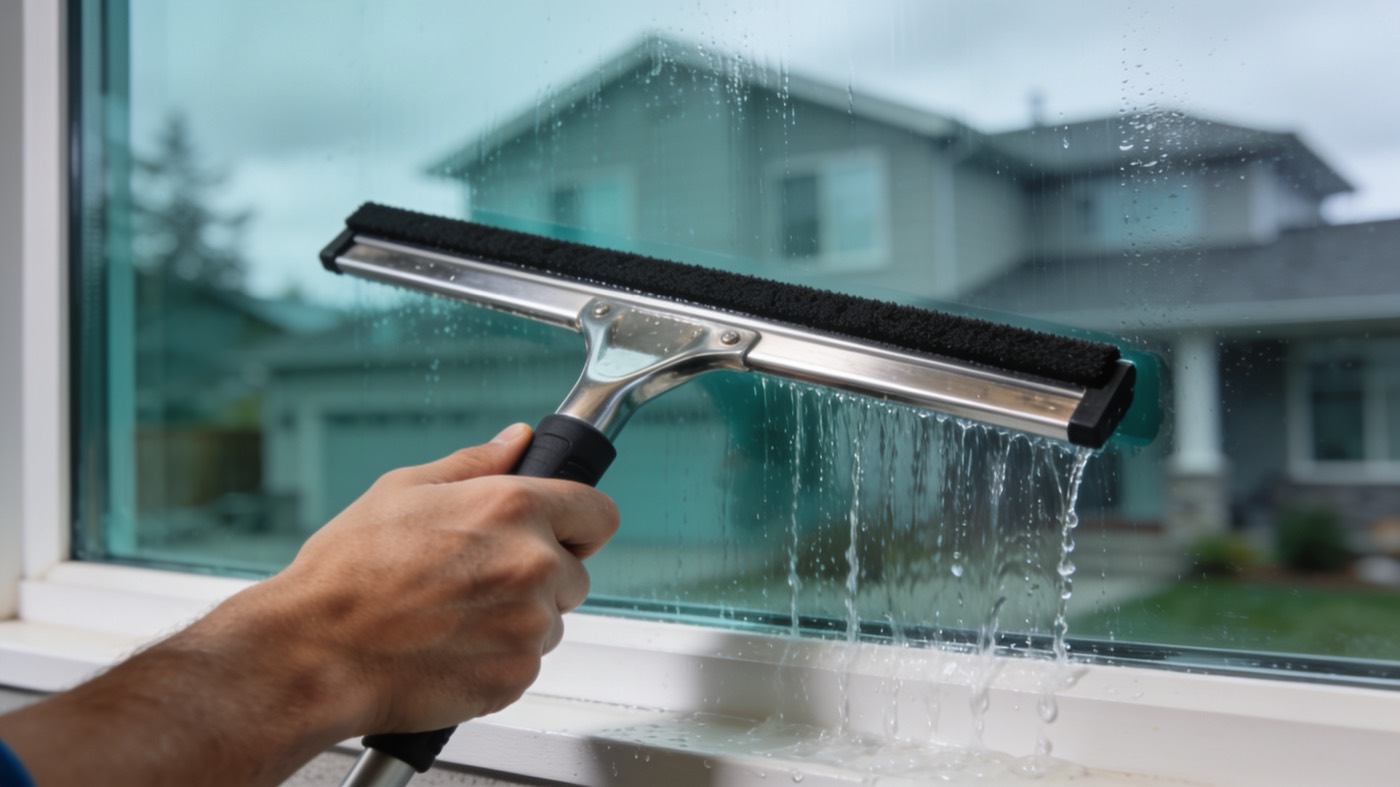
Trying to do a whole wall of windows at once is how people end up chasing dried edges around the house. We do detail work with a mop and squeegee by hand, one pane at a time, for exactly this reason. It looks slower and it finishes faster.
Interior glass needs less water and more care about what's underneath it. Outside you're removing pollen, road grit, rain spotting and growth, so volume of water helps. Inside you're mostly dealing with fingerprints, cooking film, dust and pet nose prints.
A damp cloth followed by a dry buff handles most interior panes without a bucket in sight. Lay an old towel along the sill before you start, because interior drips find hardwood, paint and window coverings.
Plenty of companies quote exterior glass only. We clean windows inside and out, because the inside is usually the half the customer looks at every day.
Dirt sitting in the frame and the sill washes straight back down onto clean glass the first time it rains, so the frame is part of the job rather than an extra. Clean the pane and leave the frame and you've bought yourself about a week.
We scrub frames, sills and panes together as one job. It's slower on the day, and that attention to detail is the reason the result lasts.
Some marks aren't dirt. Mineral deposits baked on over years, rust runs off metal fittings and railings, and construction film from tape, stickers or overspray all sit bonded to the glass and have to be lifted off rather than wiped away.
"Can you really get these windows looking clear again?" is the question we hear most often. After years of build-up, people do not expect a real difference. Watching their reaction when the job's finished is the best part of the work.
Removing that kind of staining takes the right product and the right tools, applied so the glass isn't scratched in the process. On post-construction jobs we use safe products to lift stickers, tape and paint film without marking the pane.
This is also where doing it yourself gets expensive. A blade or steel wool dragged over glass with grit trapped under it leaves scratches that no amount of cleaning undoes, and the fix is a new pane.
Three things are worth handing to a professional: height you can't reach safely, staining that's been there for years, and any job where a mistake costs more than the clean. Everything else is a weekend task.
Ladder work on wet ground is the one we'd push hardest on. Metro Vancouver mornings leave grass and moss slick well into the afternoon, and a second-storey pane is not worth it.
We're fully insured with general liability and workers compensation coverage, we've completed over 250 jobs as of July 2026, and we work seven days a week across Vancouver, North Vancouver and West Vancouver. We work with residential and commercial customers, and a free quote takes a phone call. Buildings and storefronts go through our commercial window cleaning service.
| Do this | Skip this |
|---|---|
| Wash on an overcast day or in shade | Washing in direct sun or on warm glass |
| A few drops of dish soap in a full bucket | A generous squeeze because it seems dirty |
| Lint-free microfiber, one damp and one dry | Paper towel or an old cotton rag |
| Wipe the squeegee blade after every stroke | Pulling stroke after stroke on a wet blade |
| Brush the tracks dry before any water | Hosing the tracks and making paste |
| Clean frames and sills with the glass | Glass only, then wondering why it dirties fast |
| Check the pane from an angle | Judging the result head-on |
On higher exterior glass we use a water fed pole running a 100% pure filtered water system. Filtering removes everything dissolved in the water, so each pane can be scrubbed, rinsed and then left to dry on its own with nothing left behind to make a mark. On detail work at ground level we use a mop and squeegee by hand with warm water and a small amount of dish soap.
Both work on lightly soiled glass, and neither is the deciding factor. A diluted vinegar mix and a basic glass spray will both streak if you use them in direct sun, dry them with paper towel, or leave the frames dirty. Fix the timing and the tools first, then use whichever you already own.
A smear is residue that dried on the glass. The usual causes are too much soap in the water, a cloth that has stopped absorbing, drying sunlight, or a squeegee blade that was wet when it made the next pass. Rewash the pane with less soap, out of the sun, and dry the blade between strokes.
Twice a year suits most homes here, usually spring and autumn. Properties near the water, under trees, or on a busy road pick up salt, sap and road film faster and tend to want three or four visits. Restaurants and storefronts with glass frontage are usually on a monthly or weekly schedule.
Yes. We clean interior and exterior glass, including frames, sills and panes. Interior work is a large part of what we do and it is often the half a customer notices daily.
It is worth doing, because a dirty screen drips grime back onto glass you just finished. Screens need washing rather than wiping, so we treat screen cleaning as an add-on to a window clean rather than part of the standard scope.
Spring, once the pollen has settled, and again in autumn after the leaves come down and before the wet months set in. Overcast days are ideal for the work itself, and this region supplies plenty of them.
Wash out of the sun, go light on the soap, use lint-free microfiber rather than paper towel, pull the water off with a squeegee and dry the blade between every stroke, and clean the frame and sill along with the glass. Ignore the hard water advice written for other cities, because the water here is soft.
The rest is patience and one pane at a time. When the glass is high, or the staining has been there for years, that's the point to hand it over.